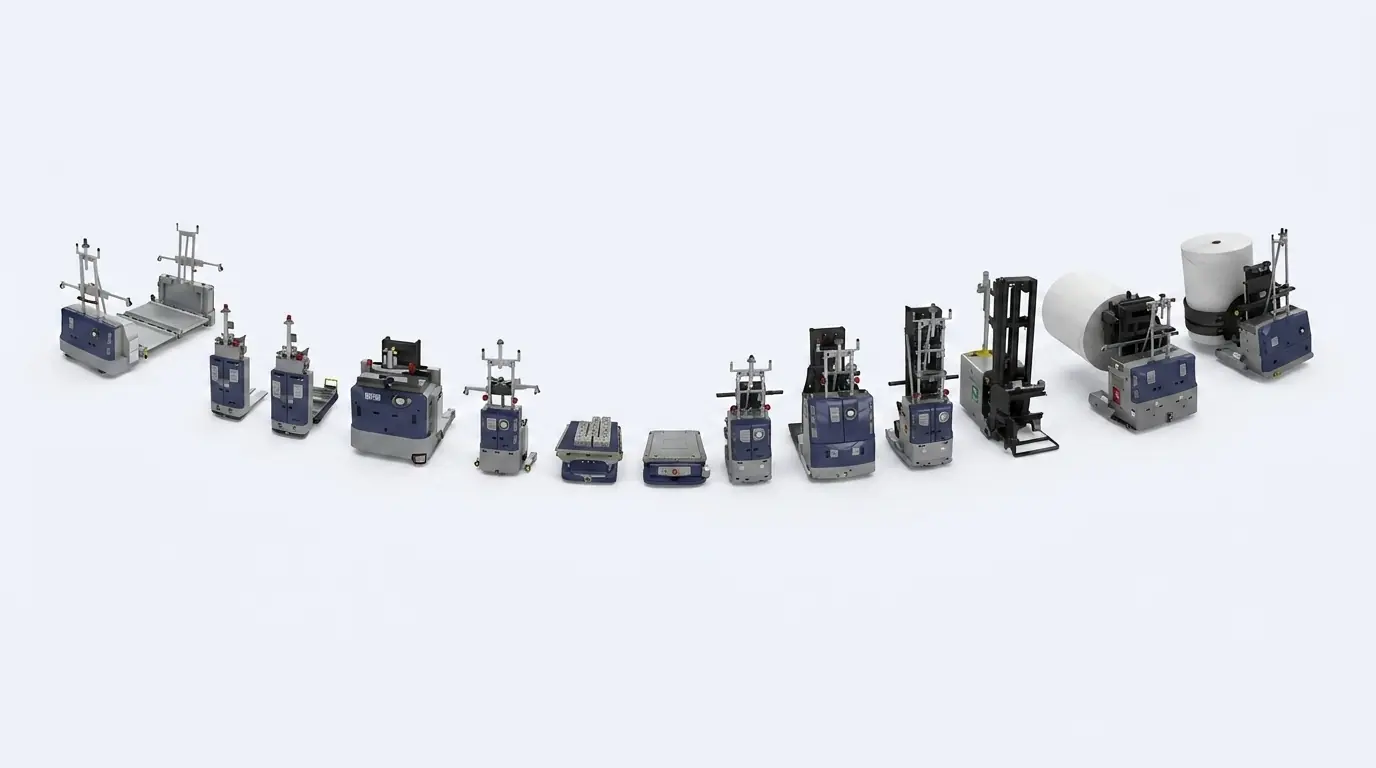
One of the first questions we hear when discussing an automated internal transport project is: "Do I need to change my racks?" The short answer: most of the time, no. Laser guided vehicles work with practically any storage type used today in warehouses across Romania — from floor block stacking to multi-depth racks with satellites. The question isn't whether an LGV can serve a given rack type, but how well that rack type fits your goods, stock rotation, and flows.
This article walks through each storage type, explains briefly how it works, when it makes sense, and how the vehicle serves it. At the end, you'll also find the selection logic — because in practice, a well-designed warehouse almost always combines several types.
Floor block stacking (block storage)
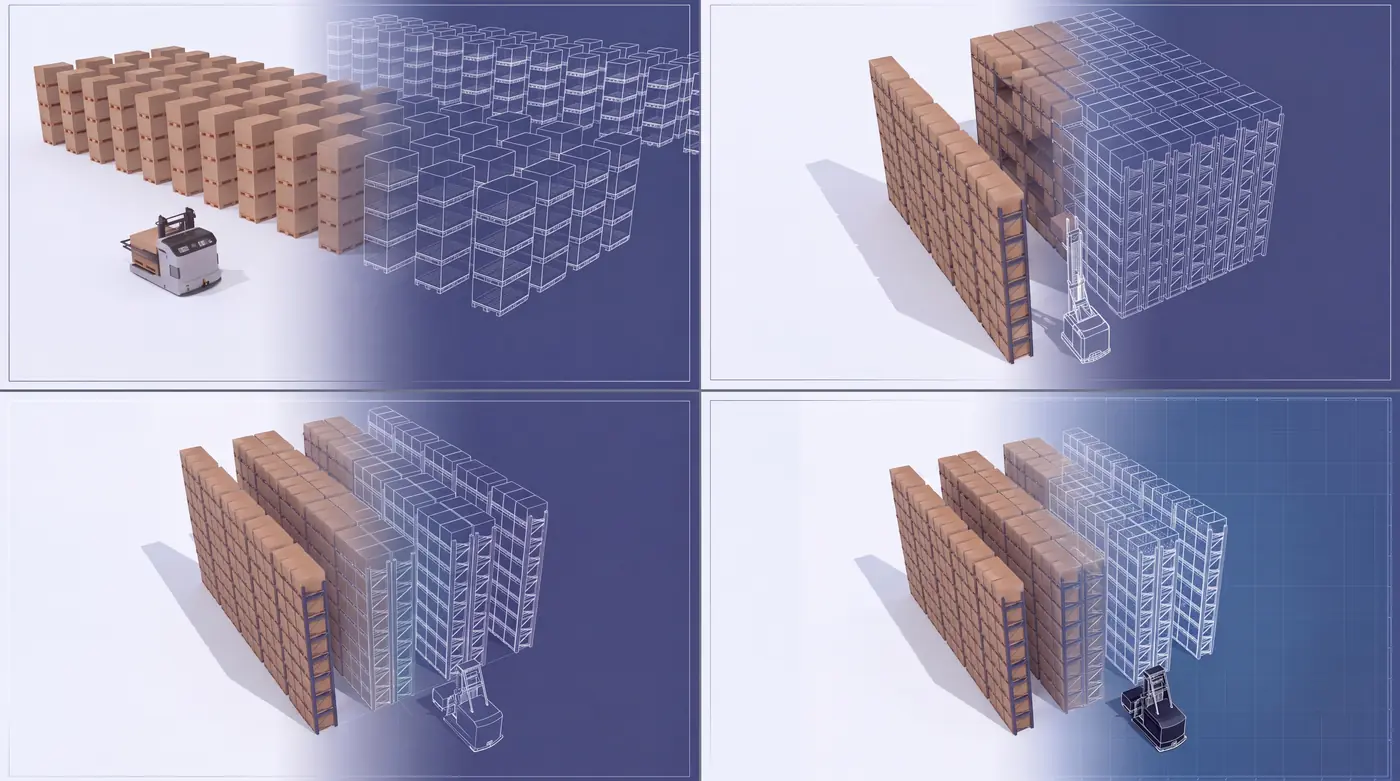
The simplest form of storage: pallets are placed directly on the floor, side by side and, if the goods allow, stacked on top of each other, in compact blocks. No racks, no investment in metal structure.
The LGV handles this very well: it positions and picks up pallets with consistent precision, builds and breaks down blocks according to clear software rules, and work aisles can be optimized because the vehicle doesn't need the maneuvering space of a forklift operator in a hurry.
When it makes sense: high volumes on few items, stackable goods, whole-batch rotation — typical for beverages, seasonal products, packaged raw materials. The limitation: LIFO access inside the block and reduced selectivity — you can't reach the pallet in the middle without moving others.
Single-deep selective racking
The industry standard: every pallet position is directly accessible, in a single row of depth. Maximum selectivity — any pallet, anytime, with no intermediate moves.
For an LGV, this is the most straightforward scenario: the vehicle places and retrieves at any level its forks can reach, and the coordination software always knows which pallet is in which position, so traceability is complete.
When it makes sense: a wide variety of items, frequent access to each SKU, hard-to-predict rotation. The cost: the lowest density per square meter — you pay for selectivity with aisle space.
Double-deep racking
Same logic, but with two positions in depth on each side of the aisle. Density increases significantly compared to single-deep, because you eliminate some aisles, and selectivity remains reasonable: the pallet at the back becomes accessible once you move the one in front.
This is where the equipment matters: serving double-deep requires telescopic forks and a positioning precision that a guided vehicle delivers consistently, shift after shift. The software intelligently manages position pairs — ideally, behind one pallet sits a pallet of the same item and batch, so no moves are needed.
When it makes sense: you have several pallets per item and want density without giving up direct access entirely. It's often the natural first step from classic selective racking toward high-density storage.
Drive-in
Drive-in racking forms channels where pallets rest on side rails, several deep, and the equipment physically enters the channel to place or retrieve. High density, relatively simple structure.
Guided vehicles can serve drive-in racking, but this is also the rack type where an honest discussion is worthwhile: entering the channel is the most delicate operation in the warehouse, with tight tolerances and risk of contact with the structure — the reason manually served drive-in racks look, after a few years, exactly the way they look. Laser guidance and controlled speed eliminate precisely this source of damage.
When it makes sense: many pallets on few items, whole-channel rotation. Keep in mind: drive-in means physical LIFO — the first pallet in is the last one out. If you work with expiration dates, this needs to be managed through batch logic, not ignored.
Gravity flow racking (flow rack) — physical FIFO
Slightly inclined channels with rollers: the pallet enters on the loading side and slides by gravity toward the unloading side. Loading and unloading happen on opposite faces of the rack, and the first pallet in is guaranteed to be the first one out — FIFO enforced by physics, not just by software.
For an LGV, this is a clean combination: vehicles feed on one side, retrieve on the other, and the flow never crosses. Correct stock rotation doesn't depend on discipline, but on construction — we detailed the difference between physical and logical rotation in the article on FIFO, LIFO, and FEFO.
When it makes sense: products with expiration dates, high-intensity flows on predictable items, buffer zones between production and shipping. The limitation: the structure cost per position and the fact that each channel is, as a rule, dedicated to a single item.
Multi-depth with radio-controlled shuttle or satellite
This is where density gets serious: deep channels, in which a satellite cart enters under the pallet, lifts it, and carries it into the channel, while the vehicle stays in the aisle. In effect, you combine drive-in density with much better operating speed, without the large equipment physically entering the structure.
The configuration is flexible: the same channels can work in LIFO (loading and unloading on the same face) or in FIFO (opposite faces), depending on how the flow is designed. The guided vehicle brings and picks up pallets at the channel mouth, the satellite does the rest, and the software orchestrates both levels of the system.
When it makes sense: high density on high-volume items, without yet moving to a fully automated warehouse with stacker cranes or level shuttles. It's often the economical bridge between conventional storage and AS/RS.
Narrow aisles (VNA)
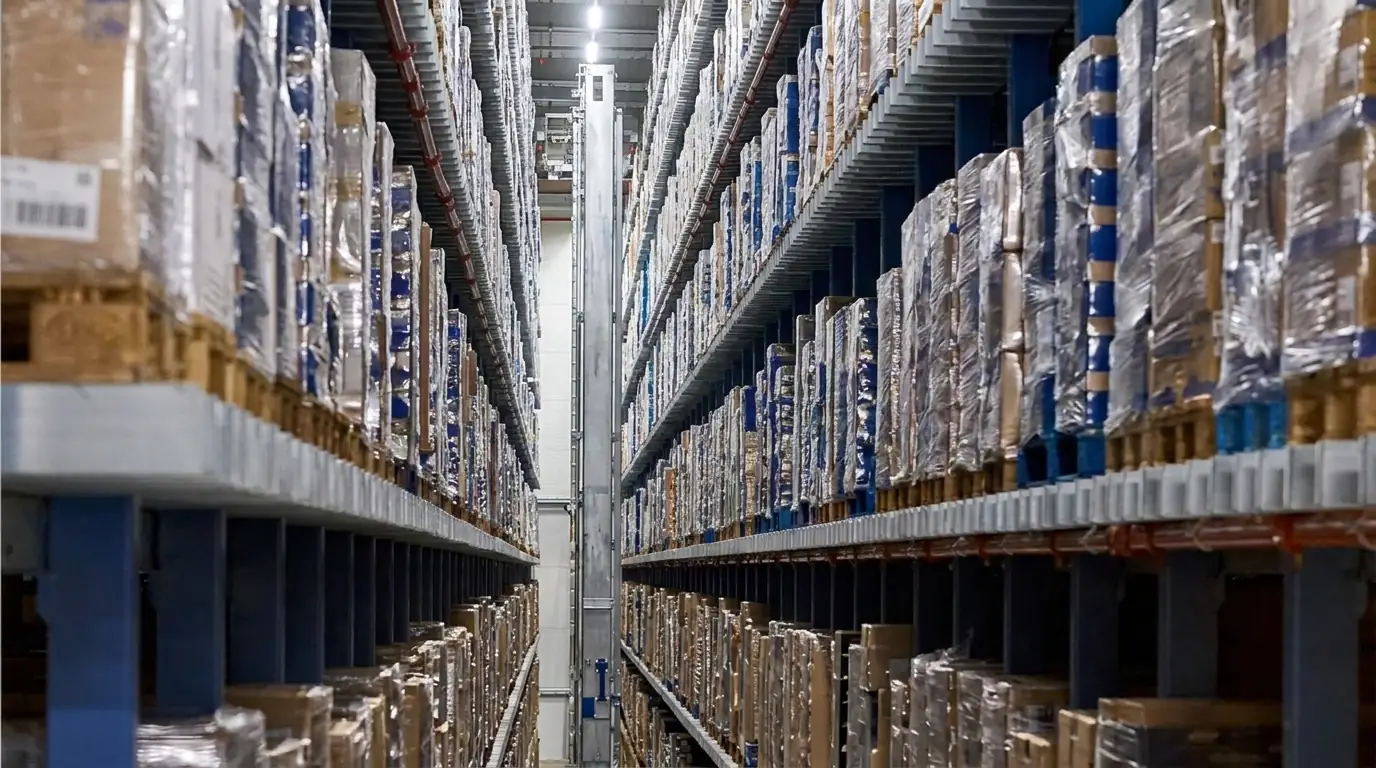
Selective racking at great height, with aisles much narrower than conventional ones — maneuvering space nearly disappears, and density increases vertically and horizontally at the same time.
This is the environment where the advantage of automated guidance shows most clearly: working tolerances are on the order of centimeters, and a laser guided vehicle operates at these tolerances without fatigue and without an operator's off days. Serving VNA with manually driven equipment requires very good operators; automated service requires only correct commissioning.
When it makes sense: tall buildings, expensive land, a wide variety of items — you want single-deep selectivity, but at a density close to high-density systems.
Mobile racking (mobile bases)
Selective racking mounted on motorized bases that run on rails embedded in the floor. The rack block sits compact, with no permanent aisles, and the aisle opens on command only where access is needed. The result: density close to high-density systems, with full selectivity — every pallet remains directly accessible, except access is awaited, not instant.
Their natural niche is refrigerated and freezer warehouses, where every cooled cubic meter costs — insulation, energy, maintenance. There, the "high density versus aisle-opening time" trade-off is almost always worth it. In ambient warehouses, they're less common, because the same density is usually achieved more simply with double-deep, drive-in, or satellite systems, with no moving parts and no rails in the floor.
Guided vehicles can work with mobile bases: the software communicates with the rack system and requests the aisle to open before the vehicle reaches it, so the flow doesn't wait. This is, however, an additional integration that needs to be planned from the start.
When it makes sense: refrigeration and freezing, where the cost of cooled volume dominates the calculation; a wide variety of items that rules out channel-based storage. The limitations: only one open aisle per block — so limited parallel work —, mechanics to maintain, and rails that must be poured into the floor during construction; adding them later is costly.
And there's one more category: automated high-bay warehouses
Beyond all the types above, there's a separate category — fully automated high-bay warehouses, with stacker cranes or level shuttles, where storage logic, equipment, and software form a single unified system. Here, the LGV no longer serves the rack directly, but works hand in hand with the automated warehouse.
It's a subject too important to cover in two paragraphs, so we dedicated a separate article to it: how an automated high-bay warehouse works — the self-supporting structure, selective or shuttle-based crane, rotation-based slotting, and fire safety.
How to choose: selectivity, density, and stock rotation
If there were a single perfect rack type, this article would have just one chapter. In reality, the choice plays out along three axes:
- How many pallets do you have per item? Few pallets across many items push toward selective racking (single-deep, double-deep, VNA). Many pallets on few items push toward high-density storage (block, drive-in, gravity flow, multi-depth).
- How does the stock need to come out? Strict FIFO with expiration dates favors gravity flow racking or FIFO-configured multi-depth systems. Whole-batch rotation tolerates the LIFO of drive-in or block storage very well.
- What does the square meter cost you, and what does the extra move cost you? Density saves space, but every pallet "buried" in depth costs extra moves on retrieval. Selectivity costs space, but every pallet is a single cycle away.
A well-sized warehouse usually combines two or three types: high-density for high-volume items, selective for the long tail of SKUs, and possibly gravity flow for zones with critical FIFO. And the guided vehicle is exactly the element that links all these zones into a single flow, with the same fleet — without each zone needing its own dedicated equipment and people.
A proper analysis always starts from your own data: items, pallets per item, inbound and outbound flows, rotation requirements. With that on the table, the right configuration stops being an opinion and becomes a calculation.
Not sure which configuration fits your warehouse? Request analysis →