
How does an automated high-bay warehouse work?
The self-supporting structure, the two operating technologies, how the software decides where each pallet sits, and what fire safety means dozens of meters up.
The self-supporting structure, the two operating technologies, how the software decides where each pallet sits, and what fire safety means dozens of meters up.
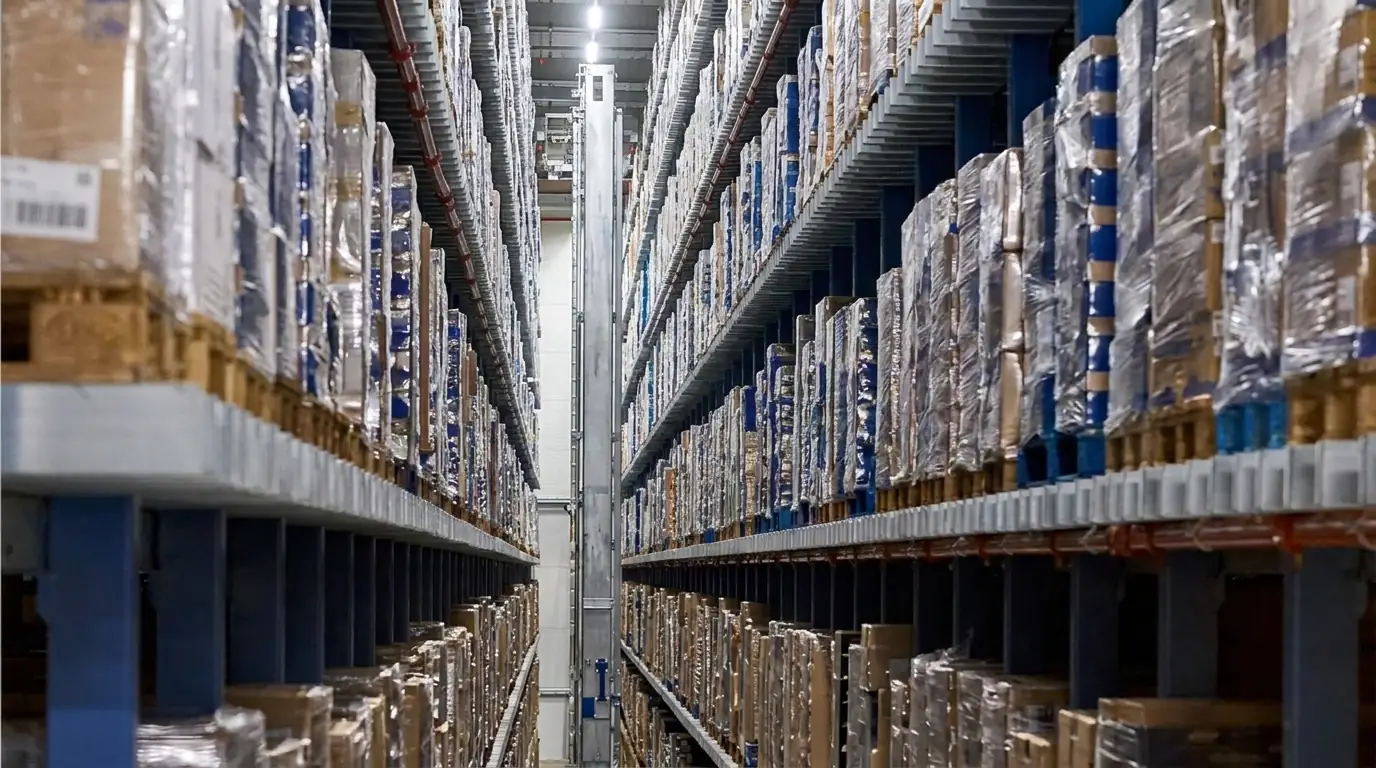
In the previous article, we covered the storage types served by an automated guided vehicle — from block stacking to multi-deep satellite racking — and set aside a category of its own: fully automated high-bay warehouses. This is the kind of structure you see from the road and wonder, "what is that very tall building with no windows?" The answer, more often than not: a self-supporting warehouse, where the racks don't sit inside a building — the racks are the building.
This article explains what that means in practice: how a warehouse like this is built, the two main operating technologies, how the software decides where each pallet goes, and — a topic few address directly — what fire safety means at heights of dozens of meters.
In a conventional warehouse, you build the building first — walls, roof, load-bearing structure — and only then install the racks inside. In a self-supporting high-bay warehouse, the order is reversed: the racks' steel structure is engineered to carry all the loads — the weight of the goods, wind, snow, seismic loads — and the walls and roof are mounted directly onto it. The racks are no longer furniture stored inside a building; they are the building.
This approach allows for heights that a conventional building would reach only with difficulty, if at all — warehouses over 40 meters tall aren't the exception; they're the natural result of no longer paying for a double structure (a building plus separate racks). In practice, you gain vertical storage capacity exactly where land is expensive and horizontal expansion is no longer an option.
At this level of automation, vertical pallet movement is handled by transfer cars — equipment dedicated to each aisle, moving on rails both horizontally and vertically. The essential difference between the two technologies isn't "how many rack types exist," but how the pallet gets from the aisle to its storage position.
Selective crane (crane store). Each aisle has its own transfer car, which serves the positions on both sides directly — single-deep or double-deep, with high selectivity: any pallet is accessible without moving another one out of the way. This is the variant that most closely resembles, in logic, classic selective racking — except access is vertical, across dozens of meters, and fully automated.
Shuttle crane. The transfer car stays at the end of the aisle and carries a shuttle cart that actually enters the storage channel, in depth, on each level. This allows for multi-deep storage — several pallets behind one another on the same level — with much higher density than the selective variant, at the cost of somewhat lower selectivity: the deepest pallet becomes accessible once the shuttle moves the pallets in front of it, depending on the channel configuration.
The choice between the two isn't about which one is "better," but about what your goods require: many different items with frequent access to each → selective crane. Few items, high volumes on each → shuttle crane, where the density gained offsets the selectivity lost.
It's also worth briefly mentioning stock rotation: the selective crane, with direct access to every pallet, supports FIFO without constraints — any pallet comes out when needed, regardless of the order it went in. With the shuttle crane, pallets in a channel typically come out in LIFO order — last in, first out — if loading and unloading happen on the same side of the channel. That's not a flaw, but a characteristic to factor into the technology choice, especially for goods with a shelf life — we covered rotation logic in detail in the article on FIFO, LIFO, and FEFO.
A detail that often surprises people in the first technical discussion: transfer cars don't just consume energy when lifting a pallet — they recover some of it on the way down. The principle is the same as regenerative braking in electric vehicles: on descent or braking, the drive motor temporarily works as a generator, and the resulting energy is sent back into the system instead of being lost as heat in the brakes.
At the scale of a warehouse with dozens of transfer cars running thousands of cycles a day, the effect isn't cosmetic: every descent with a pallet, every end-of-travel braking event becomes a small source of recovered energy, and the system "borrows" some of it for the next move. The same logic applies to the satellites working inside the storage channels, powered by lithium-ion batteries — regeneration reduces overall consumption and, indirectly, wear on the braking components.
In practice, this isn't a separate feature added at the end, but a characteristic built into how the transfer cars are driven — part of why a well-designed high-bay warehouse stays energy-efficient even at hundreds of cycles a day, per aisle.
In a warehouse dozens of meters tall, the position of each pallet isn't random. The software orchestrating the transfer cars constantly tracks each item's rotation — how often it's requested, how fast the stock is consumed — and allocates positions accordingly: fast-moving items sit in the positions closest to the input/output stations, while slow-moving ones are stored farther away or higher up.
The result is a warehouse that "self-optimizes" over time: as the season, a sales campaign, or the order mix changes, pallet allocation adjusts automatically, with no manual intervention. This is exactly the kind of decision people can't make consistently, shift after shift, but that the software applies the same way every time. The same logic applies to rotation rules — FIFO, LIFO, FEFO — which become software decisions, not a matter of discipline.
A high-bay warehouse concentrates very high value in a small footprint, often with combustible materials (cardboard boxes, film, wood pallets) stacked dozens of meters high — which is why fire safety isn't a technical detail but a project decision as important as the storage technology itself. There are, in essence, two approaches.
Sprinklers are the classic, reactive approach: they detect the fire and put it out with water, after it has already started. It's the more familiar solution and, as a rule, has a lower installation cost — but in an automated warehouse, water also means a risk of damage to goods and to the electronic equipment on the transfer cars.
Low-oxygen systems (also known as hypoxic systems) work on a different principle: they permanently keep the warehouse's oxygen level below the threshold at which combustion can sustain itself, through the controlled introduction of nitrogen into the air. In effect, the fire never gets to start, because the environment doesn't support it — a preventive approach, not a reactive one, with no risk of water damage.
The trade-off is as real as the benefit: installation costs more, and maintaining the system that continuously generates and monitors the oxygen-reduced atmosphere is a recurring cost to plan for from the outset. In addition, human access inside the warehouse, while the system is active, requires breathing equipment — the warehouse is no longer a space you simply walk into for a quick check.
The choice between the two depends on the value of the goods, their sensitivity to water, and the investment budget — but it's a discussion that has to happen during the project phase, not be added later.
A high-bay warehouse doesn't operate in isolation. Transfer cars pick up and drop off pallets at the input and output stations of each aisle, but someone has to bring the pallets there — from the end of the production line, from receiving, or pick them up for shipping and truck loading. That's exactly the role of automated guided vehicles: they connect the rest of the flow in the plant or distribution center with the warehouse's vertical "heart."
The key to integration isn't mechanical, it's software: the system that coordinates the transfer cars and the one that coordinates the vehicles must speak the same mission logic, so a pallet moves from production to storage and back to shipping without dead points of waiting. This is, in practice, the direct application of the principle we keep repeating: a single system, the same coordinated flows, from the entry gate to the exit gate.
The decision for an automated high-bay warehouse rests on three questions, in this order:
As with the storage types in the previous article, the right answer starts from your project's actual data — not from a "standard" solution.
Want to find out if a high-bay warehouse fits your project? Request analysis →
Self-supporting structures allow heights on the order of 30-40 meters, because the racks themselves carry all the structural loads — there is no longer a separate building to limit the height.
The selective crane serves each position directly, in single- or double-deep configurations, with high selectivity. The shuttle crane carries a cart that enters the depth of the channel, enabling multi-deep storage with higher density and somewhat lower selectivity.
Consumption is significantly reduced by braking energy recovery: on descent or stopping, the drive motor temporarily works as a generator and sends the energy back into the system instead of losing it. The same logic applies to satellites powered by lithium-ion batteries.
Low-oxygen systems prevent the fire before it starts, keeping the oxygen level below the combustion threshold, with no risk of water damage to the goods. They cost more to invest in and maintain than sprinklers, and human access to the warehouse requires breathing equipment.
Yes — transfer cars only serve the inside of the aisles. Automated guided vehicles connect the warehouse to the rest of the flow: production, receiving, shipping, truck loading.
The software tracks each item's rotation and assigns the positions closest to the input/output stations to fast-moving items, while storing slow-moving ones farther away — an allocation that adjusts automatically, with no manual intervention.
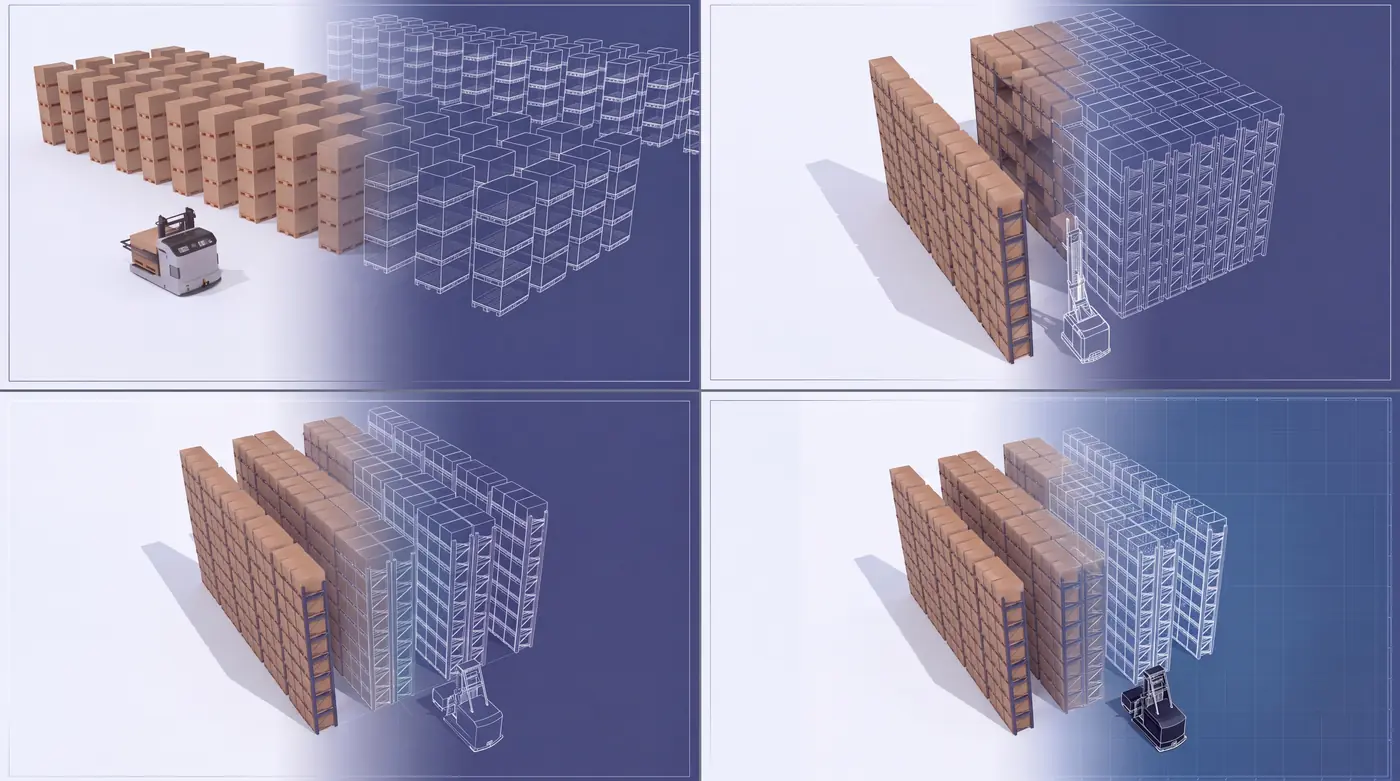
Single-deep, double-deep, drive-in, gravity, shuttle, or floor block — a guide to rack types.
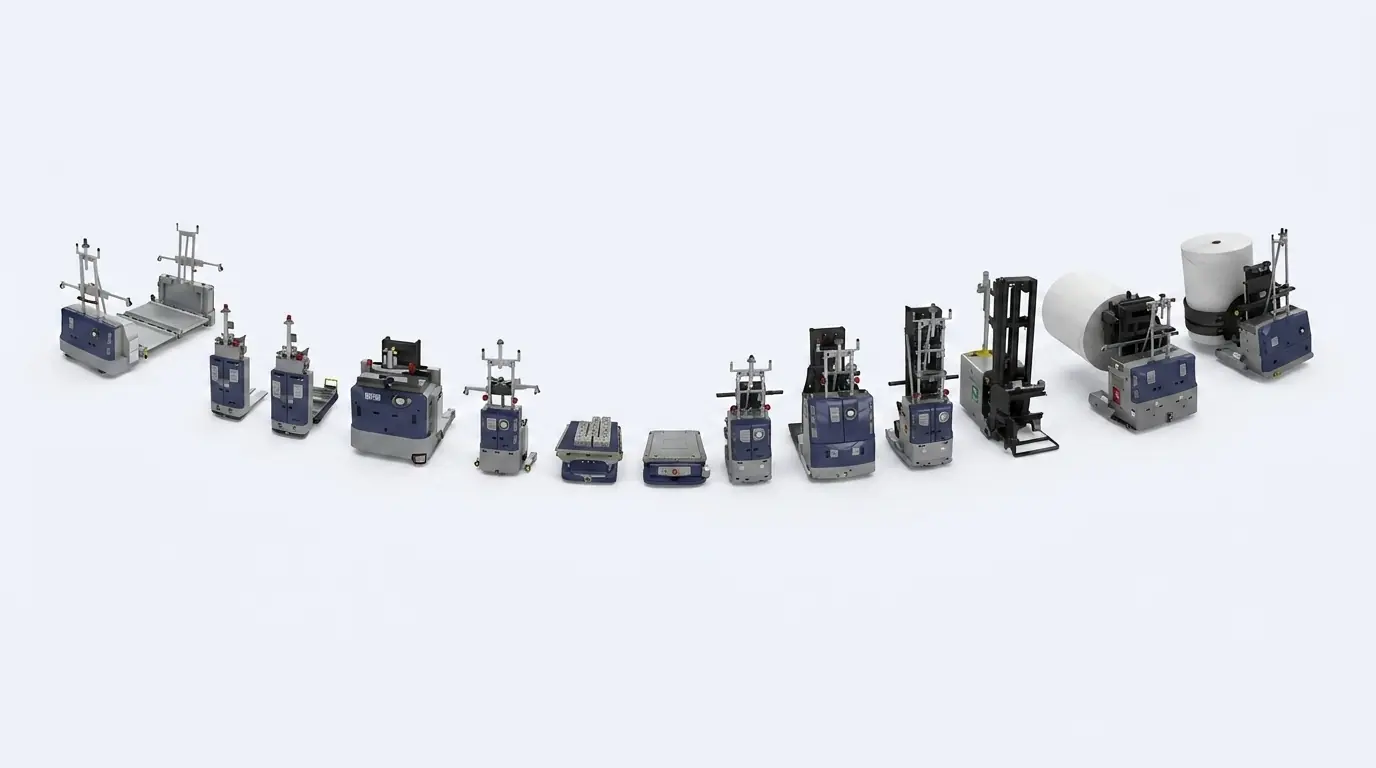
How autonomous vehicles work, what forms they take, and why there is no "standard AGV."
Fill in your project details and get an initial assessment — with the storage technology, safety system, and integration with the rest of the flow sized to your operation.
Request analysis