When warehouse automation comes up, the conversation almost always starts with costs and efficiency. Safety comes up later — usually after an incident has already happened. That's the wrong order: manually driven forklifts have, for decades, been among the most frequent sources of serious workplace accidents in warehouses and factories, and delivery errors quietly drain money and business relationships, month after month. Both share the same root, and it's worth saying plainly, without blame: people get tired. Vehicles don't.
This article covers both sides of the same coin — accidents and errors — and explains what actually changes when internal transport moves to automated guided vehicles. Including the part suppliers talk about less often: what automation doesn't fix on its own.
Why accidents happen: not bad people, impossible conditions
A good forklift operator makes thousands of maneuvers per shift. Each one demands attention to the load, the rack, the blind corner, the coworker crossing the aisle while looking at a scanner. Now add the night shift, seasonal-peak pressure, the eighth hour of the shift, maybe a second job on top. Warehouse accidents don't happen because people are careless — they happen because we ask human attention to perform without a break, at the same quality, under conditions where no human attention can perform without a break.
The typology is familiar to anyone who has run a warehouse: collisions with pedestrians in mixed-traffic zones, impacts with racking (manually served drive-in aisles wear the scars in plain sight — we wrote about this in the article on storage types), loads dropped from forks, speed maneuvers in tight spaces. And every incident carries three costs: the human one — the one that truly matters —, the direct one (goods, racking, equipment, zone shutdowns, incident investigation), and the long one, visible in staff turnover: people don't stay in places where they don't feel safe.
How an automated guided vehicle "sees": safety by construction
The fundamental difference between a manually driven forklift and an automated guided vehicle isn't that the second has extra sensors. It's that the second was built around a single obligation: never hit anything, ever, regardless of context. Specifically:
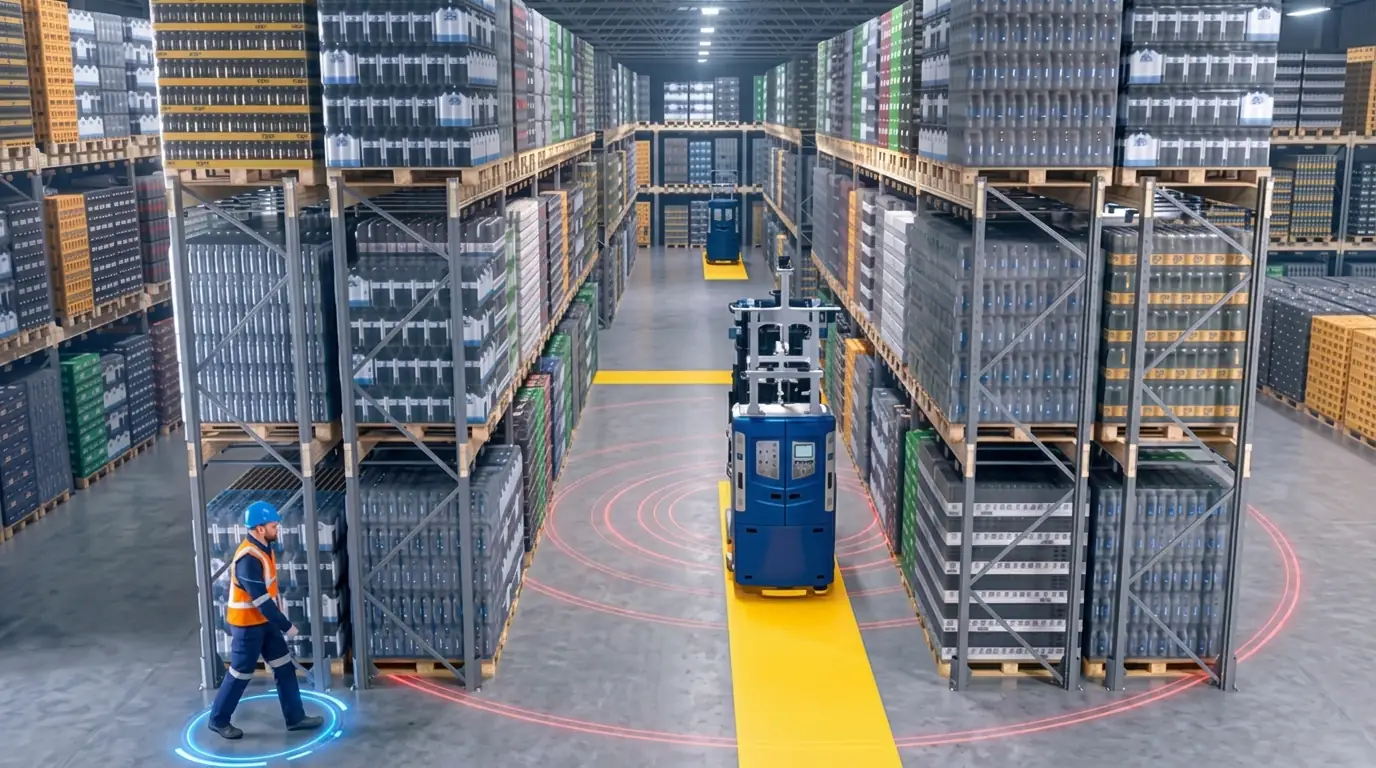
- Safety laser scanners continuously monitor the vehicle's path, with protective fields that expand and contract dynamically based on speed and direction: a wider warning field, where the vehicle slows down, and a close protective field, where it stops completely. This isn't a reaction "as good as an attentive person's" — it's a reaction guaranteed by certified safety components, the same on maneuver one and on maneuver ten thousand.
- Predictable paths. The vehicle doesn't improvise, doesn't cut corners, doesn't make the "just this once" maneuver. It runs on known routes, with zone-defined speeds — slower where there's pedestrian traffic, with acoustic and visual signaling at intersections and aisle exits. For people in the warehouse, that predictability is itself a safety feature: you always know where it's coming from and what it will do.
- The load, handled identically every time. Picking up and setting down pallets happens at the same speeds, with the same controlled acceleration, with verification of load presence and position. There's no "I lifted it too fast," no pallet pushed into the rack from a misjudged distance — which is why racks served by automation don't end up looking like manually served ones after a few years.
- Localization beyond line of sight. Laser scanners see in a straight line — but warehouses have corners, racks, and blind intersections. That's why advanced systems add a second layer: ultra-wideband (UWB) radio localization, which detects the position of people, vehicles, and equipment through radio pulses, including where the laser has no visibility — around a corner, behind a rack. The effect is twofold and worth highlighting: on one hand, the vehicle anticipates a person's presence before it "sees" them; on the other, unnecessary precautionary stops decrease too — safety and flow increase together, not at each other's expense. In mixed traffic, where people and manual forklifts share space with automated vehicles, this layer makes the difference.
- A dedicated standard. This entire architecture isn't left to each manufacturer's discretion: driverless vehicles are governed by the international standard ISO 3691-4, which defines the requirements for person detection, braking systems, operating modes, and how all of it is verified — and serious manufacturers build above the standard's requirements, not at its edge. One detail that says a lot about the standard's philosophy: it applies not only to the manufacturer, but to the integrator and the operator too. Safety isn't a spec sheet for the vehicle — it's a property of the whole system, including the warehouse it runs in.
- A detail few people think about: batteries. On classic forklifts with lead-acid batteries, the battery swap itself is a risk operation — hundreds of kilograms manhandled manually, acid, dedicated charging areas with fumes. Modern vehicles with lithium-ion batteries and inductive charging remove this entire chapter: charging happens automatically, with no physical contact — so no electric arcing — within the flow's natural windows, with no one ever touching a battery.
One confusion worth clearing up: by the hour, the person wins. By the year, they don't.
Here it's worth giving people the credit they deserve — and clearing up a confusion we run into in almost every first project conversation. Many expect the replacement to be one-to-one: "I have 10 forklift operators, so I need about 8-10 vehicles." And the first surprise is that, over a good hour, the person wins the comparison: an experienced forklift operator, in good form, beats the vehicle at individual maneuvers. They anticipate, cut the path by instinct, move faster than the vehicle allows itself with its safety fields. That's true, and there's no point pretending otherwise.
Except that's their peak speed — not their average speed. Peak is followed by fatigue, breaks, shift changes, 3 a.m., a bad day, vacation, winter with half the team out sick. The vehicle has no peak. It has a constant: the same pace in the first hour and the twentieth, Monday and Saturday, in February and at seasonal peak, with no breaks and no variation. It's the fable of the tortoise and the hare, moved into the warehouse: on the sprint, the hare always wins; over the distance of a full year, with three shifts and weekends, the one who never stops wins.
That's why sizing a fleet is never done by counting the people it replaces, but by calculating the flow it needs to sustain: how many pallets per hour, at what peaks, on what routes. Sometimes the result is fewer vehicles than people, sometimes more — but it's always a data-driven calculation, not a simple rule of three. And it's one more reason why a serious proposal starts with your flow data, not your headcount.
The other side: errors you don't see, but do pay for
Accidents are visible. Errors are silent — and precisely for that reason, more expensive than they look. The wrong pallet delivered means a return, a redelivery, and, for retail customers, a penalty for a missed delivery window. A mixed-up batch means compromised traceability exactly where an audit demands it. Book stock that doesn't match physical stock means correction counts and procurement decisions made on false data.
The root is the same as with accidents: human identification and decision-making, repeated thousands of times a day, in an environment that punishes any lapse in attention. In an automated system, this chain looks different: every pallet is identified as it enters the system, every movement is commanded by software and confirmed at execution, every storage position is known in real time. The vehicle doesn't "believe" it picked up the right pallet — the system knows which pallet is on the forks, where it picked it up, and where it's taking it, and the full history of every movement exists without anyone logging it. Identification and positioning errors aren't reduced through discipline; they disappear through architecture, because the step where they used to occur no longer exists.
It's worth saying honestly: no system eliminates every possible error — goods can leave production mislabeled, a label can be wrong at the source. What automation eliminates is the layer of errors generated by manual handling and identification — which, in most warehouses, is by far the thickest.
What automation doesn't fix on its own
Here's the part we discuss less often in the industry, but that any serious buyer needs to hear before the project, not after.
- Mixed traffic remains a reality. In almost every automated warehouse there are zones where guided vehicles, manual forklifts, and pedestrians coexist. The automated vehicle always follows its rules — but the safety of the zone also depends on marked and respected pedestrian paths, clear rules for manual equipment, and the discipline not to "cut through" an active aisle. Designing these zones is part of the project, not an afterthought.
- People need to be trained. The team working near the vehicles needs real training: what the vehicle does, how it signals, how it stops, what each signal means, how to correctly restart after a safety stop. A safe system with untrained people is a system that's only safe on paper.
- Commissioning makes the difference. Protective fields, zone speeds, behavior at intersections — all of it is configured for your specific warehouse, with your flows. The same technology, configured superficially, delivers a different level of safety than the same technology configured rigorously. It's one more reason why choosing the supplier matters more than the spec sheet.
The cost of safety can be calculated — in both directions
Incidents and errors in manual operations have a cost that can be honestly estimated: the value of damaged goods, penalties, shutdowns, and the turnover of people who leave places that feel unsafe. We turned this into a tool: our cost calculator shows you, based on your own data, how much you're paying today for accidents and errors — and how much of that cost disappears under the scenarios you set.
But beyond the calculation, there's an argument that doesn't fit into any spreadsheet row: hard labor, night shifts, and the cold are exactly why people leave warehouses. The roles that remain after automation — supervision, coordination, control — are the ones you can actually find and keep people for. And in today's labor market, that's not a soft benefit. It's a staffing strategy.
Want to see how much you're paying today for accidents and errors? Open the calculator →